Attack helicopters are tremendous battlefield assets, but their value is limited in urban, jungle, forested, and mountainous areas where obstructions block their view. Weaponry is mounted forward and must be fired by pilots who strain to see targets below and must turn to engage them. Amazingly, no one has equipped helicopters to engage targets from a high hover. Helicopters can fly up to 10,000 feet, which is well beyond the effective range of heavy machine guns and shoulder-fired missiles. Therefore, some helicopters should be converted to fire downward too.
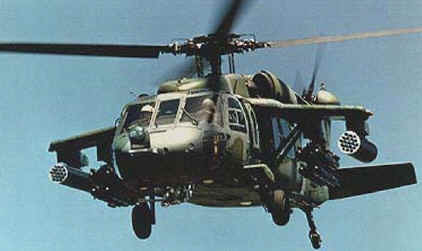 AH-60s already exist in the Special Forces but all weaponry is fixed forward.
(pictured) The inexpensive UH-60 Blackhawk helicopter can
become an RAH-60 "Gunhawk" by adding a pivoting gun station on both
sides of the fuselage, with either a .50 caliber (12.7mm) machine gun, a 20mm gatling gun,
a 25mm or 30mm automatic
cannon, or a 40mm automatic grenade launcher. Enlisted gunners in the
cabin control each weapons systems that can be aimed remotely and fired
forward, sideways, or downward. They would be seated at a weapons station in front of
a video screen wired to a video camera gun sight that can provide magnified color or
infrared images.
AH-60s already exist in the Special Forces but all weaponry is fixed forward.
(pictured) The inexpensive UH-60 Blackhawk helicopter can
become an RAH-60 "Gunhawk" by adding a pivoting gun station on both
sides of the fuselage, with either a .50 caliber (12.7mm) machine gun, a 20mm gatling gun,
a 25mm or 30mm automatic
cannon, or a 40mm automatic grenade launcher. Enlisted gunners in the
cabin control each weapons systems that can be aimed remotely and fired
forward, sideways, or downward. They would be seated at a weapons station in front of
a video screen wired to a video camera gun sight that can provide magnified color or
infrared images.
Each gunner could control the elevation and
traverse of his weapons system, just like the chin mounts in service
today. Tests are required to
determine the best weapon mix due to recoil, weight, and ballistics. The range
of a gun firing downward is unlimited, but wind becomes a factor as bullets literally rain down upon an enemy. This is a similar concept
to the
AC-130H Spectre (below) used by the US Special Operations Command, except that
a UH-60 is a much less expensive and more flexible platform that can fire
directly downward. 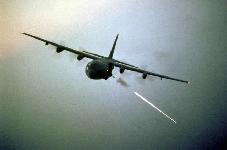
Unless major anti-aircraft systems are present, a Gunhawk can hover beyond the range of small arms, heavy machine guns, and small anti-aircraft missiles. Keep in mind that the vertical range of projectiles fired from below is much less than their horizontal range due to gravity. Most gun mounts cannot elevate to fire vertically anyway. However, ballistic floor mats may be installed on Gunhawks for extra protection from small arms fire at low levels, or large caliber rounds weakened by extreme ranges. Gunhawks should be painted "haze gray" to help them hide in the sky.
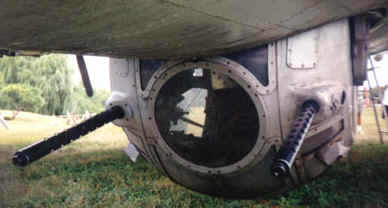
Firing downward is not new idea, it is similar to the ball turret idea used by World War II bombers. (below) The aiming technology has already been developed, and a missile countermeasure systems can protect against surprises. The Gunhawk gunners can engage targets independently without the need to turn the helicopter. This weapons system could provide unique capabilities in situations like the 1993 ranger fiasco in Somalia, where attack helicopters could not provide effective support to infantrymen trapped in a city. An RAH-60 could have taken up station high overhead for hours at a time to provide reconnaissance and rain steel upon anything below.
 A rifle company advancing in a city or
dense forest may have a Gunhawk overhead with its gunners observing all movement below with
telescopic-infrared sights to provide
immediate intelligence. Enemy forces may
not see the Gunhawk high overhead, especially at night or in cloudy weather, until rounds
begin exploding everywhere.
Raining gunfire can devastate foot soldiers since they have nowhere to
hide,
and even armored vehicles may explode as rounds penetrate their thin upper armor.
A rifle company advancing in a city or
dense forest may have a Gunhawk overhead with its gunners observing all movement below with
telescopic-infrared sights to provide
immediate intelligence. Enemy forces may
not see the Gunhawk high overhead, especially at night or in cloudy weather, until rounds
begin exploding everywhere.
Raining gunfire can devastate foot soldiers since they have nowhere to
hide,
and even armored vehicles may explode as rounds penetrate their thin upper armor.
Gunhawks would prove superior for helicopter escort missions. Current attack helicopters rely on pilots who have restricted views. Once enemy ground fire is observed, they must turn and dive to engage. This process takes several seconds, assuming they detect the source of the incoming fire. In contrast, each Gunhawk has three gunners scanning directly below and ready to instantly engage targets. A formation of four Gunhawks could assume hover positions over an LZ before transport helicopters arrive. They could provide support from guns that instantly pulverize anything that fires from below. Gunhawks are also excellent for shooting down enemy UAVs, low-flying cruise missiles, and other helicopters.
Gunhawks may seem vulnerable against an army with modern anti-aircraft weaponry. However, Gunhawks can operate at low levels with strafing runs by popping up and turning away to allow its gunners several seconds to unleash a barrage. Gunhawks would prove valuable in "mopping up" enemy units isolated in rear areas where "steel rain" encourages fanatics to surrender. Finally, Gunhawks could serve as light transports to pick up and drop off recon teams, downed pilots, or wounded. Gunhawks are a simple concept that can greatly increase the effectiveness of airpower.
©2015 www.G2mil.com