The first aircraft to attack Baghdad during the 1991 Persian Gulf war were not F-117 stealth bombers, but old B-52s that launched cruise missiles hundreds of miles from Iraqi territory. Later in that conflict, B-52s became a key weapon to pummel Iraqi forces in Kuwait with cheap, dumb bombs, and delivered 40% of all air munitions. During the 1999 Kosovo war, precision-guided munitions were little help against scattered Yugoslav infantrymen fighting KLA units in the mountains, so B-52s flew in to carpet bomb large areas.
The Air Force has scrapped half of its B-52s the over the past two decades. The remaining bombers are capable, but expensive to maintain. As a result, the need for a "B-3" has been discussed. During the early 1980s, Boeing designed a low-cost bomber based on the 747 airframe that could launch 72 cruise missiles from internal rotary launchers (below); the B-52 can only carry 20 cruise missiles. A 747 costs only 15% of a B-2, and Boeing 747 service and spare parts are available at every major airport in the world. The US Air Force needs to adopt this idea as the B-747.
B-747s each launching 72 cruise missiles per mission can devastate enemy air defenses. Once air superiority is established, B-747s can fill the B-52 high altitude bomber role by loading 72 2000-lb bombs in their rotary launchers. The B-747 is ideal for reserve squadrons since thousands of pilots and mechanics work with 747s in their civilian occupations. Enemy intelligence would find it difficult to distinguish B-747s from civilian 747 in operation around the world. This would allow B-747s to utilize airbases in friendly countries without raising alarm among local residents. A B-747 can provide any Air Force with the most modern, flexible, and cost-effective bomber on Earth. Here is a 1996 USAF paper about this concept: Transport Bombers.
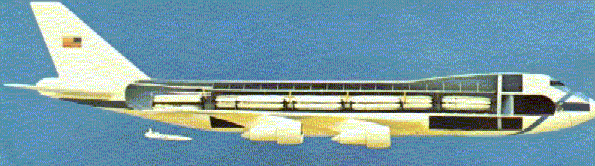
B-747s can also dominate the world's oceans. A squadron of 12 B-747s loaded with anti-ship cruise missiles can be vectored toward a enemy fleet by satellite or submarine, while E-3 Sentry AWACS provide escort with long-range radar. The squadron could launch a total of 1064 cruise missiles at a naval fleet from two directions a thousand miles away. Anti-ship Harpoon missiles are already in service with B-52 squadrons, but they have a range of just 100 miles. The US military refuses to adapt its air-launched cruise missiles to an anti-ship role because the idea frightens Admirals since ships can be attacked well beyond a Carrier Strike Group (CSG) defensive perimeter. However, other navies will not prove ignorant and employ numerous types of long-range anti-ship cruise missiles:
RADAR SEEKING - homes-in on ship radar emissions, like HARM and LRASM missiles
RADAR IMAGE - seeks a ship's radar profile, like the 84D Harpoon and Exocet
TORPEDO CARRIER - releases a homing torpedo near the fleet, like the Sea Lance
INFRARED - seeks heat produced by ship engines, like the 84E Harpoon
RADIO FREQUENCY - seeks out radio frequencies produced by communication systems
LIDAR SCANNER - scans the horizon with a laser looking for a reflection
ANTI-AIRCRAFT - cruises until its radar-equipped captive-missile finds a flying target, like a SUBSAM
These missiles can use existing technology and cost one million dollars each. If four B-747 bombers fire 1064 anti-ship cruise missiles, that is a billion dollars of munitions. However, a single modern destroyer costs over one billion dollars and has over 300 crewmen, and those are escorts. New aircraft carriers with aircraft cost $30 billion. Given that a CSG normally has around ten ships, that is some $40 billion of hardware in the target area. Even if 90% of the 1064 missiles are successfully destroyed or jammed, 106 would strike the fleet. If this doesn't sink all the ships, the B-747s can return the next day for another attack.
Stealthy Aircraft or Cruise Missiles
The US Air Force shunned cruise missiles in favor of penetrating stealth aircraft like the B-2 bomber escorted by F-22 fighters. Expensive air-launched cruise missiles were developed during the Cold war as another nuclear weapons delivery method. Afterwards most were converted into conventional air launch cruise missiles and expended in recent conflicts. The US Air Force has not procured cruise missiles the past two decades. Any fighter can carry cruise missiles and several air-launched types have been fielded by other nations. If strike missions can be performed by inexpensive aircraft launching stand-off cruise missiles, there is no need for ultra-expensive radar evading stealth aircraft. Millions of dollars were spent to develop a short-range air-launched cruise missile called the SLAM-ER, but the program ran into mysterious problems and no one explained why larger Tomahawks are not air-launched instead.
 While the US Navy
procured thousands of Tomahawk missiles for use by ships and submarines, it has
not pursued the obvious step of mounting them on Navy aircraft like the F/A-18
to allow strikes farther inland, well beyond the range of
ship-launched cruise missiles. The Navy successfully test launched
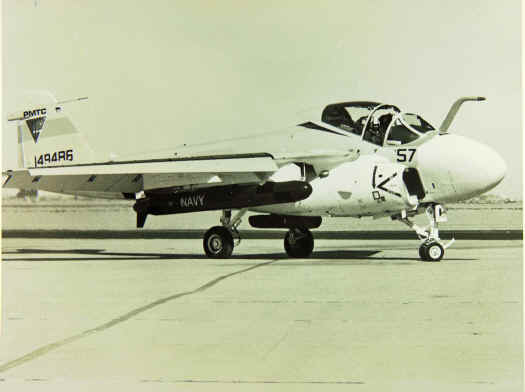
Tomahawks from A-6 bombers. (pictured) Part of this resistance may be a desire
for a stealthy carrier-based strike aircraft, which was the idea of the canceled A-12
project and now the F-35. However, a more likely reason is that
if aircraft can launch cruise missiles from well outside a CSG's defensive perimeter,
CSGs are dead. The Royal Australian Air
Force is not constrained by carrier Admirals and purchased
German cruise missiles for use by their F/A-18s and P-3s. These are smaller
missiles with a range of around 250 miles, yet this makes them so capable
that some Asian nations have complained.
While the US Navy
procured thousands of Tomahawk missiles for use by ships and submarines, it has
not pursued the obvious step of mounting them on Navy aircraft like the F/A-18
to allow strikes farther inland, well beyond the range of
ship-launched cruise missiles. The Navy successfully test launched
Tomahawks from A-6 bombers. (pictured) Part of this resistance may be a desire
for a stealthy carrier-based strike aircraft, which was the idea of the canceled A-12
project and now the F-35. However, a more likely reason is that
if aircraft can launch cruise missiles from well outside a CSG's defensive perimeter,
CSGs are dead. The Royal Australian Air
Force is not constrained by carrier Admirals and purchased
German cruise missiles for use by their F/A-18s and P-3s. These are smaller
missiles with a range of around 250 miles, yet this makes them so capable
that some Asian nations have complained.
The Earth is Round
If several aircraft launch a large array of anti-ship cruise missiles it will be impossible for a fleet to jam or destroy most of this mix, especially if they are led by several unjamable Super 8 anti-ship missiles. Surface fleets cannot defend against mass cruise missile attacks because the Earth is round. While no one debates this fact, admirals pretend that ship defensive systems can track and destroy large numbers of incoming sea-skimming missiles. The curvature of the Earth limits line-of-sight and radar detection to around 12 miles. Cruise missiles fly 550 mph, or just over nine miles a minute, so a ship has just over a minute to track and destroy an incoming cruise missile once it is detected coming over the horizon. Detection at 12 miles is very optimistic since the frontal radar and visual view of an incoming cruise missile is tiny; 10 miles is more realistic.
A bigger challenge is that ship radar systems are located thirty or more feet above the ocean surface while sea skimming missiles fly around ten feet above the surface. This means systems like Phalanx must look down and attempt to pick out tiny cruise missiles against ocean clutter produced by waves and white caps, while they fly head-on toward the ship with little radar reflection. This is why these systems are tested by having them shoot at a drone flying much higher off the surface, and only one drone at a time. Moreover, Phalanx fires a stream of bullets where it predicts the missile will be in a few seconds, yet that tiny target is always making slight flight adjustments to compensate for air turbulence while tracking its moving ship target, so the stream of bullets is likely to miss. Each Phalanx only has ammo to fire for eight seconds, and fires four-second bursts. So even if they work perfectly, each system can only shoot down two targets, then must wait 20-30 minutes until the complex reload is accomplished. A NAVROC system would prove more effective, exploding 600lb warheads near incoming missiles.
Laser Scams
As technological innovations allow solid state lasers to grow in power, the laser weapon scammers have returned to defraud the Pentagon. They were ousted a decade ago after collecting billions of dollars to demonstrate nothing, but a new crop of officers are unaware of the limitations of lasers.
 First,
lasers are line-of-sight (direct fire) weapons and the earth is round. This
means a laser cannot engage a low-flying incoming missile until detected coming
over the horizon
roughly 10 miles out. It takes several seconds for radar to track and lock onto to a
subsonic missile and aim the laser, so it will have perhaps 30 seconds
to shoot down the missile, and it requires several seconds of precise lasing to burn
through. This means if a dozen missiles are inbound, the system may be
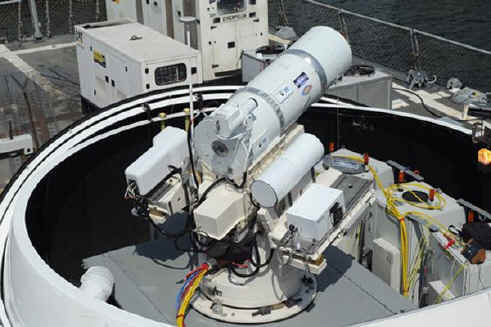
able to shoot down only one. And since the planned systems are the size of a
5-inch gun mount and need most of the electrical power from the ship to fire, a
cruiser or destroyer can carry just a couple of systems each.
First,
lasers are line-of-sight (direct fire) weapons and the earth is round. This
means a laser cannot engage a low-flying incoming missile until detected coming
over the horizon
roughly 10 miles out. It takes several seconds for radar to track and lock onto to a
subsonic missile and aim the laser, so it will have perhaps 30 seconds
to shoot down the missile, and it requires several seconds of precise lasing to burn
through. This means if a dozen missiles are inbound, the system may be
able to shoot down only one. And since the planned systems are the size of a
5-inch gun mount and need most of the electrical power from the ship to fire, a
cruiser or destroyer can carry just a couple of systems each.
Second, particles in the air reflect and distort laser beams, even on clear days. This limits their effective range to only a couple miles. This is a complex topic and several, short technical explanations can be read on the Internet, such as this article and this one from a US Navy research lab which states that even in clear weather:
"A number of physical processes affect and limit the amount of laser energy that can be delivered to a target. These effects are interrelated and include thermal blooming, turbulence, and molecular/aerosol absorption and scattering. These processes affect the laser intensity profile by modifying the refractive index of the air, which causes the laser beam wavefront to distort. Wavefront distortion results in enhanced transverse laser beam spreading, and can severely limit the amount of energy that can be propagated. The maritime environment is particularly challenging for high energy-laser (HEL) propagation because of its relatively high water vapor and aerosol content. In the infrared regime, water molecules and aerosols constitute the dominant source of absorption and scattering of laser energy, and represent a limitation for HELs propagating in a maritime atmosphere."
None of this is secret, yet one reads articles and comments on internet forums by "experts" and senior officers who seem unaware of this severe limitation. In addition, lasers are worthless in rain, fog, and haze since energy is quickly lost. Even if lasers are greatly improved with magical breakthroughs, an enemy can choose to attack during inclement weather when lasers are useless.
Third, ship radar systems are located 30 feet above the ocean surface while sea skimming missiles fly around ten feet above the surface. This means systems like Phalanx, which is used to target the current laser test system, must look down and attempt to pick out tiny missiles against ocean clutter produced by waves and white caps, while missiles fly head-on toward the ship with little radar reflection. This means radar may be unable to track missiles in mildly rough seas so cannot aim the laser. This is why these systems are tested by having them shoot at a drone flying much higher.
Fourth, a cruising missile is always making slight flight adjustments to compensate for air turbulence while tracking its moving ship target, so a laser is likely to miss due to the tracking/firing delay. To make matters worse, ships and aircraft move! They vibrate and bounce up and down. Computer software can try to predict these movements and compensate, but not perfectly, and cannot predict the slight movements of the incoming missile.
Finally, lasers do not destroy upon contact but require several seconds of EXACT lasing to burn through. Here is a video of a recent ship test. Note the weather is clear and the slow flying plastic drone is high in the sky. This exposes its large delta wing area for laser heating. Nevertheless, it takes ten seconds of laser contact to cause a fire. An inbound sea skimming missile presents a far smaller target, and if lasers proliferate, missile makers will introduce shiny stainless steel nose cones to reflect most laser light. They may also program the missile to fly a tight spiral path to the ship the last mile to evade countermeasures, like the Russian Kornet anti-tank missile. Lasers look great in tests when the target and laser are close by and both are motionless on the ground, but when both are bouncing around, accuracy is non-existent.
Lasers can blind optical systems and pilots (as the Brits did in the Falklands) so small lasers may be useful in that role. A far better idea is to mount active protective systems used by some armored vehicles. These are much smaller and cheaper than big laser systems, yet could only cause them to detonate outside the ship before impact. This would still result in damage as the momentum (kinetic energy) from the missile fragments penetrate unarmored ships. Yet that is all a large ultra-expensive laser can accomplish since they cannot hope to detonate an incoming missile until after several seconds of precise lasing proves possible as it nears a ship.
Anti-Missile Scams
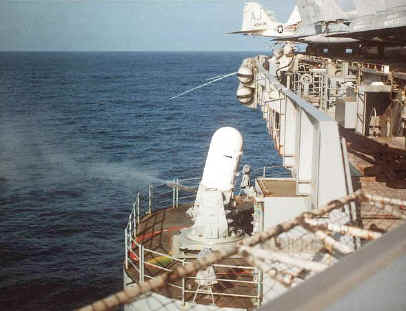
The Rolling Airframe Missile (RAM) is very limited for ship defense, which is why the US Navy never conducted testing. It fires a flurry of small infrared-seeking anti-aircraft missiles at an incoming cruise missile. However, a cruise missile has a very small turbofan jet that puts out little heat. In addition, the heat source is in the rear and shielded by the body of an incoming missile. Finally, RAMs looking for heat sources would be confused by hot rocket exhaust from other outbound RAMs and hot bullets from a Phalanx 20mm guns. (below) To make matters worse, a rocket firing anti-ship missile may be developed to bewilder and overwhelm ship defensive systems. As this cruise missile approaches a ship, it fires a variety of supersonic Hydra 70mm rockets in the same manner aircraft now fire Hydras from a nineteen-tube M261 lightweight pod. Most of these unjammable high-speed rockets would miss a ship, but some may impact while all overwhelm and confuse ship defensive systems.
 India and China
purchased advanced Novator anti-ship cruise missiles from Russia.
The 3M-45 (SS-N-27 Sizzler) is notable for being subsonic in the cruise phase
while utilizing a supersonic dart for the final 20 km (12.4 miles) of the
attack. Other versions have a dual radar/infrared seeker to overcome
countermeasures and weather problems. These missiles have a maximum range
of 300 km so they are compliant with the Missile Technology Control Regime, to
which Russia is a signatory.
India and China
purchased advanced Novator anti-ship cruise missiles from Russia.
The 3M-45 (SS-N-27 Sizzler) is notable for being subsonic in the cruise phase
while utilizing a supersonic dart for the final 20 km (12.4 miles) of the
attack. Other versions have a dual radar/infrared seeker to overcome
countermeasures and weather problems. These missiles have a maximum range
of 300 km so they are compliant with the Missile Technology Control Regime, to
which Russia is a signatory.
The Chinese are capable of building a larger version with much greater range, however, 300 km (182 nm) is plenty of range to attack a CSG since these missiles can be launched from aircraft, shore batteries, or submarines. The Chinese built the YJ-62 anti-ship missile with a range of 280 km (176 nm) uses a frequency agile radar seeker (e.g. frequency hopping), which is very difficult to jam. They are also testing the YJ-63 air launched anti-ship missile with an electro-optical seeker so the missile can be flown into its target by operator via a televised image.
No matter what shipboard defensive systems are used, each would be lucky to track and shoot down a couple of incoming cruise missiles during a mass attack given their limited engagement opportunity. Decoys and jamming may confuse some missiles, however, they also confuse and blind ship-based anti-missile systems. In addition, dumb Super 8 missiles and a cruise missile unleashing two dozen Hydra rockets cannot be jammed. Although the US Navy's expensive Aegis radar system can launch and guide dozens of large anti-missile missiles at once, the radar clutter produced by incoming missiles, ship decoys, and ship defensive systems during the two minute engagement period would be immense. Large solid-rocket burning Standard missiles would likely be downed by the ship's own RAMs and Phalanx bullets, while the cooler low flying incoming cruise missiles slip past.
US Navy officers do not dispute this vulnerability but point out that aircraft from CSGs can shoot down cruise missiles. However, they face time constraints as well. While a Hawkeye airborne radar aircraft is always flying above a CSG to provide radar coverage out to 140 miles, its ability to detect small cruise missiles just above the surface is roughly one-third that. Therefore, the Hawkeye radar operator can warn the fleet that 1000 cruise missiles are incoming (at nine miles a minute) and will strike in five minutes. This gives ship crews time to go to general quarters, but is not enough time for the few airborne fighters to shoot down more than a couple cruise missiles each. The Navy's new SM-6 missiles guided by Hawkeye may shoot down some subsonic missiles, but hitting an incoming missile with a missile requires luck.
In reality, fighters would be foolish to fly toward an area where ships will soon unleash a massive anti-missile volley. This lack of warning is yet another fleet weakness. Sailors do not sit at their weapons stations 24 hours a day. Unless a fleet happens to be on alert at "general quarters" five minutes may not be enough time to man and arm all weapons systems. Ship captains hate to arm these weapons systems anyway because they may shoot at whatever moves, which is dangerous for a CSG with its own aircraft flying around.
A CSG has sophisticated and capable ship defensive systems that should be able to protect the fleet from several incoming cruise missiles. However, dozens of incoming missiles would be overwhelming, which may be coordinated with ballistic missile and submarine attacks. The fleet is likely to expend all its decoys and much of its anti-missile weaponry defending against such an attack and it would take hours to rearm these systems. Using decoys presents problems as ships in a formation may divert missiles toward other ships. Finally, it takes only one cruise missile hit to sink a modern warship packed with munitions and fuel.
Meanwhile, another mass cruise missile attack can occur at any time. The Russians have sold supersonic Sunburn missiles to several nations, cutting the time ships have to destroy an incoming target even further. Some nations may resort to modern kamikazes, sending outdated supersonic jet fighters zooming in just off the surface. The pilot could fire his 20mm gatling gun and dozens of rockets and eject just prior to impact.
The challenge of shooting down incoming cruise missiles is complex since weapon systems are mounted on a ship that is moving forward and rocking and rolling, while the tiny cruise missiles bounce around from air turbulence as they streak toward a ship. Meanwhile, friendly aircraft are flying around while terrified gunners mates arrive at their stations to perform a task they have never really practiced as their expensive missiles are rarely fired. The friendly fire threat is great unless ships are in line, thus making them easier targets for missiles and submarines. The problem that ship systems may target friendly aircraft or missiles fired by other ships is never addressed since no solution exists.
There are plans to mount powerful lasers for ship defense. Lasers are useless in fog and rain, something an enemy can exploit. Lasers must concentrate their beam on one point of a missile for several seconds to burn through, and longer if the missile nose is made of reflective stainless steel. This is nearly impossible since its ship is bobbing and moving forward as the missile does the same. A final problem is that lasers can only fire at one target and each requires tremendous ship electrical power, limiting their numbers.
The US Air Force is excited about the the potential of using high-power microwave weapons to "fry" the electronics of ground-based systems and incoming missiles. This has not been fully demonstrated and presents difficulties because range is limited to a few hundred meters. Such weapons seem ideal for ship defense, although they present problems with "friendly frying"; e.g. damaging electronics on the ship itself or nearby ships. Since ships are large targets, frying an incoming missile's electronics may do little good a few hundred meters away as it would continue onward and likely strike its target. Nevertheless, it is an area worthy of research.
Airborne Radar and Jumbo Jets
The US Navy recognized these weaknesses so has focused on shooting down attacking aircraft before they unleash missiles. Older Soviet bombers had limited range so CSGs could anticipate the general direction from which they might attack and projected anti-air operations in that direction with the help of aerial tankers. American admirals felt they had a good chance of intercepting Soviet bombers before they could launch their missiles. Meanwhile, the fleet would be warned and could maneuver to evade distant incoming missiles. Toward the end of the Cold War, the Soviets developed longer-range bombers and long-range cruise missiles, but these were devoted to strategic nuclear attack. The Cold War ended before these systems were available for a naval bomber role.
The fleet defense strategy of shooting down cruise missile launching aircraft became obsolete as long-range jumbo jets and long-range cruise missiles appeared. Modern jumbo jets have such great range that naval bomber variants can fly long enveloping routes to approach a fleet from any direction almost anywhere on Earth. Given the limited number of fighters and aerial tankers, it is impossible to maintain continuous air patrols beyond a 500 miles defensive perimeter. Fighters with tanker support can fly extended missions, but when and which direction? Naval bombers can attack at any time from any direction, and only a few carrier aircraft can be maintained airborne 24 hours a day.
Land-based naval bombers may be escorted by large airborne radar aircraft like AWACS that have twice the detection range of a fighter's small radar system. In addition, the large radar systems in modified commercial jets like AWACS scan in all directions, while a fighter can only "paint the sky" to detect objects in a cone shaped area directly to their front. Therefore, finding enemy bombers requires intelligence of where to look or just luck. If a land-based naval bomber flight with a airborne radar escort happens upon a carrier fighter on deep patrol, they would see him first and have plenty of time to change course. Keep in mind that a fighter aircraft on patrol cruises no faster than a commercial passenger jet.
Aircraft carriers carry Hawkeye airborne radar aircraft with a 360 degree detection ability out to 140 miles. However, there are only 4-5 per CSG, so only one can remain airborne all the time and it remains near the carrier. This is why carrier Admirals like to mass their CSGs so more aircraft can provide perimeter defense, yet that only provides a huge mass of ship targets.
A difficult question is which modern American commercial jet is best for modification into a naval bomber. In general, the 747 with four engines has twice the payload as the two-engine 737 and 787. On the other hand, it burns twice as much fuel per mile and is limited to 10,000 ft runways, instead of 8000 ft for the two smaller jets. The 747 has twice the range of the 737, but the newer 787-8 has even greater range because its newer design and lightweight composite airframe provides 20% greater fuel efficiency. Of course the 737 and 787 have a smaller radar profile and are harder to see and hit with weaponry. On the other hand, a 747 can carry 72 cruise missiles while they can only carry around 35. In addition, each aircraft requires the same aircrew, so a 747 is more efficient, although it maintenance costs are higher with four engines.
| Boeing Jets | Range miles | Length | Max Seating | Cruise | Price |
| 737-700ER | 5510 | 129 ft. | 189 | Mach 0.78 | $70 mil |
| 747-400ER | 7670 | 232 ft. | 524 | Mach 0.85 | $220 mil |
| 787-8 | 8500 | 202 ft. | 223 | Mach 0.85 | $140 mil |
The prices quoted above are Boeing's "sticker" price for a single aircraft. Discounts are the norm for large orders, but aircraft costs may double to "militarize" these airframes. Keep in mind that each B-2 bomber cost $2 billion each, or $2000 million. The US Navy buys F/A-18E/F fighter-attack aircraft for around $80 million each (the production cost only) and the new F-35C is expected to cost $100 million in each, excluding development costs. In summary, a naval bomber based on a modern passenger jet design may cost less than a fighter aircraft!
The 747 is the most capable option, but much more costly. The 787 is the most efficient with greater range. The 737 cannot fly across the Pacific, although it can fly from California to Hawaii fully loaded. Boeing developed a 737 airborne radar variant for Australia that can air refuel, so that is an option to extend range. The new 737-700ER has nine auxiliary fuel tanks that can be removed if more cargo space is desired.
The Best Naval Bomber
The 737 may not be the best aircraft for naval strike missions because of its limited range, but is the best option because it is a much less expensive choice and already in service with the U.S. Navy. The 737 was selected in 2004 as the platform for the Maritime Multi-mission Aircraft (MMA), designated the P-8 (below) to replace old propeller-driven P-3s. This is a sophisticated aircraft capable of maritime surveillance and attack, although its primary role is anti-submarine warfare so has limited space for munitions. In addition, the Navy is buying 737s modified to carry passengers and cargo (designated the C-40) to replace ageing C-9 support aircraft.
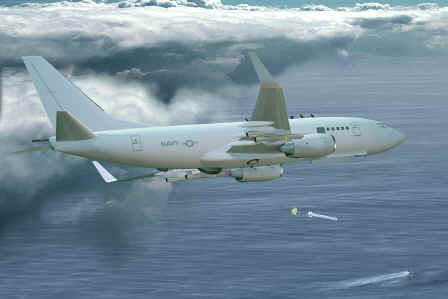 Admirals should recognize that P-8s are very vulnerable
to air attack if they operate alone. They can be located by
powerful shore-based radar systems and enemy fighters can easily gun them
down. Recall the the 2001 incident where the Chinese took offense at a US
Navy EP-3 snooping offshore and dispatched fighters to force it
down. As a result, P-8s cannot safely patrol within 1000 miles of an enemy
coastline, perhaps 2000 miles if the enemy has aerial tankers. Moreover, patrolling
an enemy's coastline to provide advance warning of enemy threats is something CSGs desperately need.
Admirals should recognize that P-8s are very vulnerable
to air attack if they operate alone. They can be located by
powerful shore-based radar systems and enemy fighters can easily gun them
down. Recall the the 2001 incident where the Chinese took offense at a US
Navy EP-3 snooping offshore and dispatched fighters to force it
down. As a result, P-8s cannot safely patrol within 1000 miles of an enemy
coastline, perhaps 2000 miles if the enemy has aerial tankers. Moreover, patrolling
an enemy's coastline to provide advance warning of enemy threats is something CSGs desperately need.
Admirals should recognize the value of procuring E-737 airborne radar aircraft to escort P-8s near enemy shores. These are in production for Australia and Turkey. E-737s are needed as escorts for fleet screening operations, a mission performed in World War II by small "disposable" destroyers. It should become standard practice in fleet operations that pairs of E-737 and P-8 aircraft conduct continual patrols between the enemy and a CSG to provide advance warning. In addition, CSGs would discover that E-737s operating from nearby land bases provide superior air control support for carrier strike aircraft than the small propeller-driven E-2D Hawkeye. The larger jet-powered E-737 has greater cruise speed to fly with jet attack aircraft and far more range than the Hawkeye and more powerful radar.
Once the idea of Navy E-737s is accepted, the idea of a B-737 naval bomber can arise. The P-8 already includes a small weapons bay. It would cost little to develop a B-737 to serve as bombers to carry around 35 Tomahawk cruise missiles. The C-40 "737" cargo version is in production and only rotary launchers and launch doors are needed. Rotary launchers are easily removable so a B-737 can also carry cargo to support other missions. B-737s would always be escorted and commanded by a sophisticated E-737 or P-8, so they needn't complex and expensive communications and command stations. An all-737 fleet can greatly reduce pilot and maintainer training costs and simplify logistics. For example, the same CFM56-7 engines are used by the C-40, E-737, and P-8. Boeing has also designed a 737 SIGINT variant that the US Navy is considering to replace its EP-3s.
Funding for B-737s may be problematic as carrier admirals view them as a threat to their cherished CSGs. Eliminating just one CSG could pay for several squadrons land-based navalized 737 aircraft. Any nation wishing to become an instant naval power need only a squadron of these three 737 variants. Development costs for the E-737 and P-8 have already been paid, so the cost is small.
A squadron of militarized 737s would also have an impressive strategic strike capability since they can also launch land attack cruise missiles and drop dumb bombs at targets ashore. A 737 squadron would prove superior to an entire CSG in sea control and strategic strike roles at only 5% of the cost. Manning and maintenance crews for this squadron would total less than the crew of a single destroyer. Maintenance costs would be low since 737s are very common which need not "deploy" during peacetime since they can cruise 20 times faster than a surface fleet to quickly go into action anywhere on Earth and cannot be sunk by submarines or mines. There are many roles that only a CSG can fill. Fleets of surface warships are needed to support amphibious and expeditionary operations. However, E-737s, P-8s, and B-737s can rule the oceans and strike inland targets with far less risk than a CSG at as fraction of their cost.
Naval Bomber Tactics
The example of four 747 bombers launching over 1000 cruise missiles at a fleet is certainly feasible, but such billion-dollar missions are overkill. If the bombers are given bad intel about the fleet location and direction, all missiles miss. Since missiles would be launched from 500 to 1000 miles from the fleet they would take over an hour to reach their target area. If the fleet disperses or changes course shortly after these missiles are launched, all may miss. However, missiles should be programmed to turn back after passing their target area and sweep though nearby areas several times until fuel is exhausted.
A naval bomber mission involving eight 737s is practical and effective. They would operate in two flights of four aircraft that attack from two directions, right angle from one another to ensure one volley of missiles has a broadside target; it is difficult for a missile to hit a ship head-on. Therefore, the anti-missile tactic of turning the fleet toward an incoming volley of cruise missiles will not work if another volley is incoming at a right angle. Each flight would consist of an E-737 airborne radar aircraft (below), a P-8, and two B-737 bombers loaded with missiles. The P-8s small weapons bay may be loaded with several anti-aircraft cruise missiles, similar to SUBSAMs, while smaller Harpoon anti-ship missiles may be carried under wing for individual targets of opportunity. Each B-737 would have 35 anti-ship cruise missiles of various types.
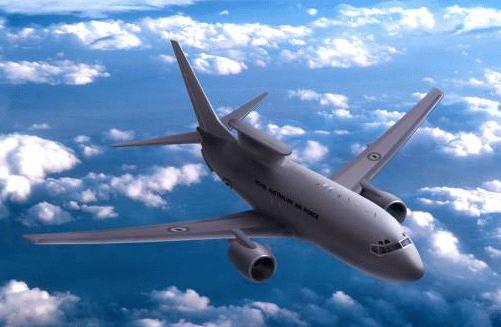 This force
would need solid intel about
an enemy fleet
location and heading.
The E-737 and P-8 would lead the way 100 miles ahead of the two B-737s
in each flight. This lessens the radar profile and allows the B-737s more
time to avoid trouble. The E-737s greater radar range allows the flight to avoid
surprises from enemy aircraft, which
could be large land-based aircraft or carrier fighters tanked up for an extended patrol. This would be odd, but they may have
made a lucky guess that an attack was incoming or tipped off by their naval
intelligence. Most aerial contacts may be neutral commercial aircraft or
ships the bomber flight want to avoid lest an enemy agent send out an
alert.
This force
would need solid intel about
an enemy fleet
location and heading.
The E-737 and P-8 would lead the way 100 miles ahead of the two B-737s
in each flight. This lessens the radar profile and allows the B-737s more
time to avoid trouble. The E-737s greater radar range allows the flight to avoid
surprises from enemy aircraft, which
could be large land-based aircraft or carrier fighters tanked up for an extended patrol. This would be odd, but they may have
made a lucky guess that an attack was incoming or tipped off by their naval
intelligence. Most aerial contacts may be neutral commercial aircraft or
ships the bomber flight want to avoid lest an enemy agent send out an
alert.
If the E-737 airborne radar detects a threat immediate evasive action would ensure that aircraft in the bomber flight are safe. Keep in mind that a fighter on patrol cruises no faster than a 737, so bombers just need to change course to keep their distance. As the bombers approach the 1000 mile to target mark, they need a final update from naval intel. If no update is possible the attack may be aborted depending on the size of the target, the total inventory of anti-ship cruise missiles, and the likelihood that the target fleet may have changed course since the last report.
Although the B-737s can unleash their 140 missiles at the 1000 mile point, the attack could fail should the target ships change course shortly thereafter. Since enemy aircraft are unlikely to be found more than 500 miles from a CSG, the flight may wait until it is closer to the target and await another target update before launch. During this mission, the lower flying P-8 uses its infrared and optical sensors, its maritime radar, and signal intelligence capability to watch for surface threats so the flight can divert if necessary.
It would be nice if the naval bomber flight could acquire its own target information prior to launch. The P-8's signal intelligence sensors may be able to track a fleet 1000 miles away using triangulation with the P-8 in the other flight by tracking the fleet's communications or radar emissions. It could also launch a supersonic disposable UAV to overfly the target fleet. However, probes warn the fleet of an impending attack. More fighters would be launched and sent on deep tanker-supported patrols while sailors man battle stations and the fleet makes a sharp turn. There are passive intelligence options to determine fleet direction and speed: submarines, fishing boats, coast watchers, satellites, spies, or signal intercepts. In some cases, a fleet is in a stationary defensive posture to protect a landing as was the case in the Battle of Okinawa, so targeting is not an issue.
If a decision is made to attack, both flights would begin a lengthy launch sequence. The two flights of B-737s would be several hundred miles apart and launching/firing from different angles. Keep in mind that cruise missiles fly only 550mph, so they would not shoot off ahead of their bomber flying at the same speed. This allows each bomber to "crab" to one side to lay out a neat row of 35 cruise missiles flying abreast. A few of these would be Super 8s, designed to fly faster so they arrive before the sensor-guided missiles. Super 8s and perhaps rocket firing cruise missiles would arrive sooner to overwhelm, confuse, and exhaust fleet defenses.
One question is the missile spread. Should missiles be launched toward a narrow or a broader target area to ensure some will hit? Should missiles be launched so they all arrive simultaneously? This ensures fleet defenses are easily overwhelmed, but allows ships maximum use of sensor decoys. If missiles arrive in two waves one minute apart, ship decoys would have been expended on the first wave, leaving them open for easy targeting. Whatever tactics are used, some of the 140 missiles launched from four B-737s will strike ships.
Anti-ship missiles can become more deadly with software changes. As the missiles approach the target area, they can begin to fly a winding "snake" path so their sensor scans a bigger area, just like when fighter aircraft snake to "paint" the area ahead. This also makes them impossible to hit with gun or laser anti-missile systems. In addition, since most missiles will miss due to the wide targeting spread or if confused by decoys, they should be programmed to back track to the target area, flying a slightly different route, until they find something to hit or run out of fuel.
Such battles seem
unfair
as the naval bombers face little risk and can return the next day for another
attack. Since warships are packed with fuel and explosives, the 1000 lb
warhead of a single cruise missile can sink a ship. During the 1983 Falklands war, the HMS
Sheffield (below), was hit by a single air-launched Exocet anti-ship missile.
The damage was not fatal since the missile failed to explode but the ship ignited and
burned until it sank.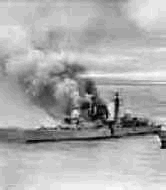
The P-8s may carry a few anti-aircraft cruise missiles to launch just ahead of the B-737s broadside. Enemy aircraft would be so overwhelmed by the 140 incoming anti-ship cruise missiles they would not notice the few seeking to destroy them. In addition, an enemy fighter pilot seeing dozens of cruise missiles flying in from one direction would know that enemy bombers launched them. He may heroically embark on a supersonic one-way suicide mission to shoot them down without fuel to return. Incoming anti-aircraft missiles may shoot him down, or at least disrupt his pursuit.
These naval bombers launched their missiles over 500 miles from the target fleet and turned for home at top speed long ago, so they are likely beyond range. 737s can fly much faster than their cruise speed. A fighter may catch them if he is patrolling near maximum range of 500 miles from the fleet and if he happens to be near the path of their incoming missiles and if he happens to see the missiles low near the surface, then he may be able to chase and shoot down bombers, if he was lucky enough to guess their route back home.
Even if all these things happen, the E-737's more powerful radar would see him first and alter course to avoid the fighter's forward-looking radar cone. The E-737s may have rear-facing anti-aircraft missiles to fire while the P-8 is equipped with towed missile decoys and other countermeasures. Finally, fighter aircraft from the bomber's airbase may launch with tanker support during the attack to engage enemy fighters who heroically attempt a one-way pursuit effort. Meanwhile, another group of naval bombers may arrive an hour later for a follow-on attack, catching the severely damaged fleet off guard as they attempt to rearm defensive systems and save damaged ships.
It is a good idea to add wing-mounted AMRAAM long-range anti-aircraft missiles to E-737s. While a big jet should avoid fighters, one may detect a fighter approaching at high-speed that is lucky or has been tipped off by intelligence sources that enemy bombers are in that area. Before an E-737s turns to flee, it may let an AMRAAM fly that may kill the pursing fighter. It may also have rear-mounted AMRAAMs. However, E-737s can kill fighters on patrol just like snipers. Given their superior radar, they may close on a patrolling fighter from its flank and launch an AMRAAM from 100 miles away. If the fighter continues its straight path with his frontal radar scanning forward, it may be hit with no warning.
Naval bomber flights may be accompanied by fighters from aircraft carriers or land bases supported by aerial tankers. They can shoot down enemy fighters on patrol with guidance from the E-737s, or sink lone enemy ships located by the P-8. They may also join a strike, flying behind the cruise missile barrage to take advantage of the chaos while launching anti-ship missiles from 100 miles out. Many of today's naval experts scoff at the idea that a fleet could be attacked by 140 missiles at once. They seem unaware that prior to World War II, experts scoffed at suggestions that 140 aircraft could be assembled for a mass attack, and unlike cruise missiles, aircraft require trained pilots and aircraft carriers or airfields.
Fleet Defensive Tactics
Fleets may attempt to avoid long-range cruise missile attacks by changing course once an hour, similar to the zigzag tactic used during World II to evade submarines. However, this burns twice as much fuel and slows the fleet's advance. In addition, a fleet cruising at 25 knots would travel only 30 miles by the time cruise missiles launched an hour away arrive. Some 140 cruise missiles arriving from two directions would cover a wide swath across the ocean. Fleet course changes would need to be long and sharp to evade this threat, and these random turns must be made just after missiles are launched. This may be futile if missiles are programmed to fly a search pattern over a target area. Fleet formation is another problem since ship defensive missiles may target friendly ships and aircraft.
Another option is to position destroyers some 500 miles from the fleet to form a huge defensive perimeter and provide adequate warning for a course change should one detect enemy bombers or cruise missiles. However, escorts also protect fleets from submarines so the carrier becomes an easier target for submarines while a destroyer operating by its lonesome is an easier target for submarines. In addition, CSGs have few escorts nowadays, not enough for a massive defensive perimeter. If a bomber flight happens upon a lone destroyer, the P-8 should see it in time to divert the flight while the P-8 unleashes its wing-mounted Harpoons at the destroyer. Otherwise, the bomber force launches two dozen anti-ship missiles at the destroyer from two angles at a safe stand-off distance and returns home.
A surface fleet doesn't stand a chance against a mass cruise missiles attack. The example used here is a small attack by four 737-size naval bombers launching a mix of 140 missiles. Assuming a fleet could shoot down or confuse 90% of these incoming missiles, 14 would strike ships with devastating results. In addition, naval bombers would return home unscathed and return the next day to finish off a fleet in disarray. Launching 140 expensive missiles during one attack may seem outrageous, but with new destroyers costing $2 billion each and new CSGs costing $30 billion each, $140 million for 140 cruise missiles is tiny, less than the monthly operational cost of a CSG! This is why surface fleets must disperse and hide until naval bombers are destroyed by other systems, as discussed in Chapter 6.
Some naval experts assert that mass cruise missile attacks are not possible because inventories are too small. Exactly! Nations are wasting far too much money on costly platforms rather than stockpiling precision munitions. The entire 1982 Falkland's naval war revolved around the employment of just five Exocet anti-ship missiles, which devastated the British fleet when fired from common jet aircraft. Many Argentine jets were later lost trying to drop dumb bombs on ships. Had Argentina acquired 100 Exocets instead of a worthless cruiser, they might have won!
Big Jet Aircraft Can Rule the Oceans
Keep in mind that B-737 rotary bomb racks can carry 2000 lb bombs instead of cruise missiles. In many low-intensity and even medium intensity conflicts, marines ashore would encounter large numbers of enemy infantrymen. With the Navy's admitted shortfall in naval gunfire, marines rely on busy carrier aircraft for support. While an F/A-18E/F can deliver seven 1000 lb bombs, a B-737 can deliver thirty-five 2000-lb bombs. If bombs are needed far inland as was the case in Afghanistan, the F/A-18E/F can only deliver four 1000 lb bombs requiring several aerial refuelings. In such cases, carrier admirals should agree that sending two B-737s to pummel enemy infantry with 70 2000 lb bombs is a better idea than sending 36 F/A-18E/Fs. Basic bombing is not the primary mission for B-737s, but it is a capability. In addition, the rotary bomb racks can be removed so it can serve as a cargo transport.
This is the future of naval warfare. Land-based militarized passenger jets will rule the oceans. Perhaps these large naval aircraft with a crew of a dozen should be recognized like ships; christening a B-737 the USS Texas for example. Aircraft aboard aircraft carriers cannot protect the fleet from these "airships" as they haven't their speed nor longer range radar. Airborne fleets flying at 600 knots are far more capable than a surface fleet chugging along at 25 knots while vulnerable to submarines and sea mines. Navies have the financial resources for naval bombers if funds are redirected from surface fleets. A modern destroyer costs as much to man and operate as a dozen of militarized 737s. Some 30,000 anti-ship missiles can be purchased for the price of a new supercarrier and their annual operating costs are zero! Admirals must accept that fleets of large commercial jets can safely clear the oceans of surface ships at a far lower cost and risk.
©2015 www.G2mil.com