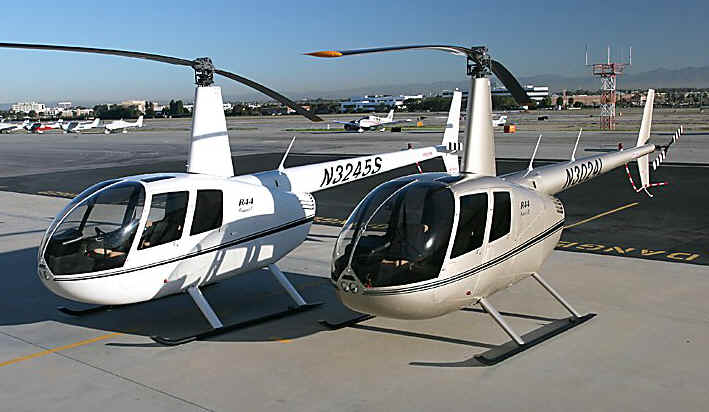
Air Cavalry can dominate future land warfare. Unfortunately, the US military focuses on ever larger, more expensive, and more powerful attack helicopters. Meanwhile, civilian aviation has developed small, inexpensive helicopters like the Robinson R44 series that cost just ~$400,000 retail!
SPECIFICATIONS
 An
army can leap
into the future by using small helicopters as the grunts of air cavalry units. Today's air cavalry in the 101st
Air Assault Division fight like soldiers riding in stagecoaches, i.e.
Blackhawk helicopters. They are vulnerable while airborne and must dismount to
fight. If the Army provides each soldier with his own Pegasus winged horse, air cavalry
can rule the open battlefield. A modern
air cavalry battalion can employ small helicopters, which attack like a swarm
of hornets piloted by enlisted troopers with no co-pilot. Cavalry
battalions (squadrons) can develop formations and
tactics to coordinate dozens of attacking helicopters. Each helicopter
will carry
one pilot who operates a 7.62mm machine gun and one of these weapons packages:
An
army can leap
into the future by using small helicopters as the grunts of air cavalry units. Today's air cavalry in the 101st
Air Assault Division fight like soldiers riding in stagecoaches, i.e.
Blackhawk helicopters. They are vulnerable while airborne and must dismount to
fight. If the Army provides each soldier with his own Pegasus winged horse, air cavalry
can rule the open battlefield. A modern
air cavalry battalion can employ small helicopters, which attack like a swarm
of hornets piloted by enlisted troopers with no co-pilot. Cavalry
battalions (squadrons) can develop formations and
tactics to coordinate dozens of attacking helicopters. Each helicopter
will carry
one pilot who operates a 7.62mm machine gun and one of these weapons packages:
- a .50 caliber heavy gatling gun and a Mk-19 40mm grenade launcher
- four Hellfire missiles with a laser designator or 70mm FFAR rocket pods
- two Sidewinder anti-air/anti-radar/anti-tank missiles
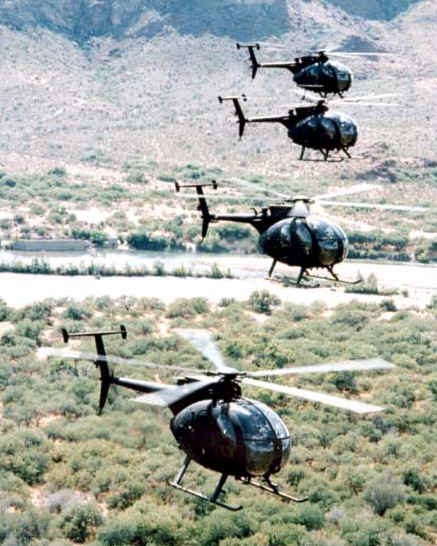
These packages are interchangeable so a unit can tailor its firepower to match its opponent. Close-in fighting will be done by these "disposable" helicopters like the Robinson R44, fighting in large groups like the larger "Little Birds" shown above. Dozens can swarm in and destroy an armored unit in minutes. A small, agile helicopter with little heat signature will be difficult to hit. Most importantly, these helicopters cost less than some spare parts for today's attack helos. An army must develop tactics to coordinate dozens of helicopters swarming onto an enemy force. Of course a soldier flying an unarmored helicopter around the battlefield is vulnerable, but less vulnerable than a soldier running across a field with 50 pounds of gear.
= Air Cavalry Battalion

- Headquarters & Service battalion
- Scout Company
- Cavalry Company x 2 - each with 42 helicopter horses
- Maintenance and Ordnance Company
In large attacks, AirCav may join with larger helicopters as swarms of small helos engage the enemy while Apaches watch from a safe distance and engage targets of opportunity. The Hellfire-equipped horses charge, select targets, and slow around 2000 meters away to engage, while the .50cal/40mm gun horses fly closer with evasive maneuvers to draw and exchange gunfire. They will take and inflict casualties, while they distract anti-aircraft gunners from the larger AH-64s unleashing missiles from thousands of meters away.
 If
enemy air defenses are formidable, RAH-60s may fire Hellfire-size rockets
from a safe distance to saturate the area just prior to the attack. After the armored
force is devastated and in chaos, RAH-60 "Gunhawks"
appear high overhead to saturate the area with direct downward fire to "mop
up" infantrymen. As enemy
soldiers abandon their vehicles, the horses move in for a turkey
shoot. UH-60Ms control operations from a safe distance while
supporting EH-60s jam and fire Sidearm missiles at enemy radar. HH-60L Medevacs arrive after the fighting has slowed.
UH-60Ms may help medevac
or external sling damaged horses back to base.
If
enemy air defenses are formidable, RAH-60s may fire Hellfire-size rockets
from a safe distance to saturate the area just prior to the attack. After the armored
force is devastated and in chaos, RAH-60 "Gunhawks"
appear high overhead to saturate the area with direct downward fire to "mop
up" infantrymen. As enemy
soldiers abandon their vehicles, the horses move in for a turkey
shoot. UH-60Ms control operations from a safe distance while
supporting EH-60s jam and fire Sidearm missiles at enemy radar. HH-60L Medevacs arrive after the fighting has slowed.
UH-60Ms may help medevac
or external sling damaged horses back to base.
This will not result is a clean victory because a capable enemy will shoot down lots of cavalrymen before their armored vehicles are destroyed. However, cheap helicopters are a small price to instantly destroy an armored unit. After the enemy is mostly destroyed, aircav can return to base and rearm for another engagement. Most opponents will surrender, but some fanatical units may put up a fight. In such cases, infantry take over the nasty task of mopping up. This is not a futuristic concept, all the equipment is available today and three dozen tiny attack helos cost less than an Apache helicopter. It's time to give each cavalryman his own flying horse and charge into the 21st Century.
©2015 www.G2mil.com