One of the greatest threats to modern warships are diesel-electric "DE" submarines. They use powerful diesel engines to deploy, but switch to electric and run on batteries to hide. They can only cruise six knots with battery power, yet they are nearly impossible to detect. Compare the heat and noise emitted by a gas-powered lawn mower to that of an electric one and you get the idea. If they stop completely and sit on the bottom, they are impossible to find as they produce no propeller noise or water disruption. DE subs can do this in straits or sea lanes and listen for the sound of large ships. If one comes in range, it can float up to periscope depth to take a look, and fire torpedoes if it desires.
The only way to destroy DE subs is to catch them in route to their hunting grounds or when they recharge their batteries every few days by running their diesel engines. Another weakness is they have an endurance of only two months, meaning they need to visit a port or a submarine tender for fuel, food, and other support. Finding and sinking DE subs requires patience and the right equipment. Fixed-wing aircraft and helicopters can be used, but they have limited endurance and generate a lot of noise that warns DE subs to hide. Surface ships have the same problem; their engine noise announces their arrival to submarines.
Surprisingly, no navy has constructed a DE ship that can switch to quiet electric propulsion when hunting submarines. This does not require new technology since DE engines already exist on submarines and the US Navy's ocean surveillance ships. A small ship is best for submarine hunting as they are quieter, harder to see on the surface, more maneuverable, and a smaller target for submarines. While cruising slowly on electric power a DE ship would produce no heat for detection at night or in poor daytime weather, which submarines may detect with infrared periscopes. A DE corvette is an ideal size for a sub hunter with a displacement of less than 1000 tons and a submarine hunting helicopter on board.
A DE corvette could literally go fishing, silently cruising slowly on electric power or sitting still in an area DE submarines are thought to operate, just waiting for a DE sub to run its diesel engines to recharge. DE corvettes may operate in groups where several fish for DE subs while another operates as bait by cruising around at 20 knots on loud diesel power in hopes of enticing a DE sub to the surface. Old stripped down destroyers may be employed as bait ships in this game. DE corvettes may also form a screen whenever surface ships enter or depart port to protect them from attack.
DE corvettes would also prove very effective in port defense, prowling silently on electric power while searching for small boats or anything along the shoreline indicating naval commando activity. Silent DE corvettes are perfect for amphibious and special operations. At nightfall or in fog they can switch to electric to go silent and cold and come slowly over the horizon to shore to pick-up or drop off reconnaissance or commando teams, then depart back over the horizon to safety.
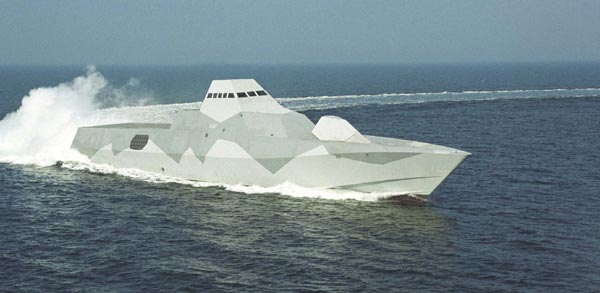 All corvettes need a stealthy design like the
Swedish Visby
class (right), which has flat angles to reflect radar away from the
sender. Its hull is made of layered plastic to save weight
and nearly eliminate a magnetic signature that most sea mines seek. An
added advantage is that the sun doesn't heat ship surfaces during the
daytime, so it doesn't glow at night in infrared viewers.
All corvettes need a stealthy design like the
Swedish Visby
class (right), which has flat angles to reflect radar away from the
sender. Its hull is made of layered plastic to save weight
and nearly eliminate a magnetic signature that most sea mines seek. An
added advantage is that the sun doesn't heat ship surfaces during the
daytime, so it doesn't glow at night in infrared viewers.
However, the Visby is not diesel-electric, it is diesel-gas turbine. This is common among corvettes since diesels provide great fuel efficiency while gas turbines kick in for bursts of speed. This allows the Visby to reach 35 knots and is a great design at only 600 tons, but for a DE corvette a top speed of 25 knots is fine. A speed of 35 knots is not needed, not for mine hunting, not for patrolling since it burns too much fuel, and not for anti-submarine warfare. Ten knots makes little difference trying to avoid anti-ship missiles or aircraft. It would only make a difference while pursuing small boats, but then it has a helicopter. Finally, corvettes operate in unfamiliar shallow waters with reefs, sandbars, and underwater rocks, so going fast is unwise.
While running on electric, a plastic-hulled DE corvette would be safe from mines since they are activated by magnetic signature or engine noise. Homing torpedoes are acoustic, seeking a ship's engine noise or the water disruption caused by a high-speed ship. Most types of anti-ship missiles, like Harpoon and Penguin, rely on infrared sensors. The only signature a Visby type DE corvette would have is a radar reflection, and that is reduced by more than half by enclosing exterior systems and using angled flat panels. It could be hit by wire-guided torpedoes but a submarine must stay at periscope depth to guide those visually, and if a DE corvette turns away from the torpedo while opening fire it would be a difficult to hit. DE corvettes and all surface combatants should have laser "dazzlers" mounted so that lookouts can instantly blind periscopes, aircraft, or whatever threat appears. A visible laser is best so the threat can be instantly seen and targeted by gun crews and aircraft, rather than the traditional method of finger pointing.
The only serious threat to DE corvettes are traditional weapons guided by the human eyeball. This is why DE corvettes would be most effective at night, where they are literally invisible while running on electric once the captain announces: "Rig for ultra quiet, blackout, coolout, ponchos on deck." Ultra quiet is common sense and so are blackout conditions, but coolout and ponchos on deck? Modern infrared sights are very effective, they can see a man standing at 2000 meters. DE corvettes may operate close to an enemy shoreline, approaching within meters to drop off or pickup reconnaissance or commando teams at night.
DE corvettes must conduct tests to eliminate their infrared signature. Shutting off the diesels eliminates most all the signature, but what about stoves inside the ship, or the ships' heating system? If it is below freezing outside, would the heated interior of a DE corvette cause the ship to glow? While some things can be insulated like computers or located in a ship's interior, other steps may be required. The ship's heating system may be cut off, or turned down. Air conditioners may be shut down as they produce heat as well, and outside air vented through the ship. Crewmen should remain inside the ship, but if they need to venture outside to help commandos aboard or to fix something, they must wear ponchos lined with special insulation to hide most of their body heat from detection, as described in this article: combat ponchos.
Corvette Tenders
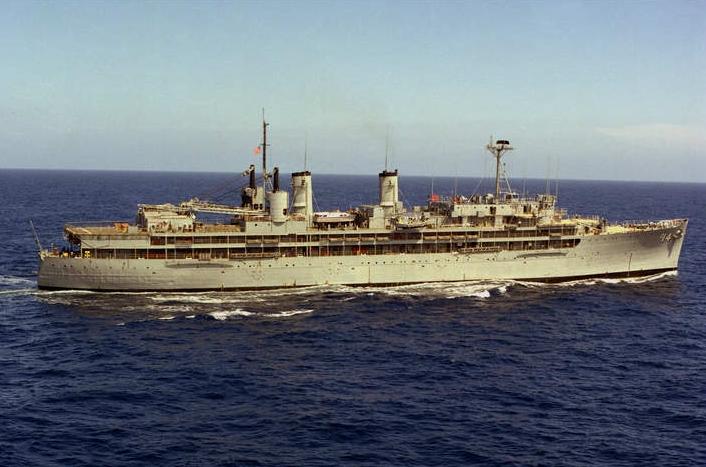
If a navy plans to conduct expeditionary or amphibious operations, it needs to deploy DE corvettes and sustain them in remote locations. Small ships are difficult to maintain forward-deployed since they lack much of the organic maintenance support and crew comforts of larger ships. Therefore, corvette squadrons need tenders, like the retired Yellowstone Class AD-41 destroyer tender. (below) A deployed squadron needs two tenders to keep one on station while the other journeys to a distant port for replenishment. The squadron headquarters would remain embarked on the deployed tender at sea with larger warships in high-threat environments, or in low-threat areas it may drop anchor in a small cove at an offshore island, although it may move every few days depending on the enemy threat.
 After a couple weeks on patrol, each
corvette would tie up to its tender for a few days of rest, replenishment, and
repairs. These tenders can also support smaller patrol boats
in their area, like US Navy PC-1s. In more lethal environments, the tender
would have to
remain far offshore with destroyers as corvettes pull alongside for just a few hours
for replenishment and other urgent business. During long deployments, the
fleet commander would discover these tenders can help support his cruisers
and destroyers too, making them even more valuable.
After a couple weeks on patrol, each
corvette would tie up to its tender for a few days of rest, replenishment, and
repairs. These tenders can also support smaller patrol boats
in their area, like US Navy PC-1s. In more lethal environments, the tender
would have to
remain far offshore with destroyers as corvettes pull alongside for just a few hours
for replenishment and other urgent business. During long deployments, the
fleet commander would discover these tenders can help support his cruisers
and destroyers too, making them even more valuable.
Tenders would have specialized repairmen for the corvettes and a large spare parts block. It would also host the squadron headquarters for the helicopters they embark, which would include a helicopter maintenance support section and large parts block. The corvette squadron headquarters would oversee the personnel manning on each corvette, moving sailors who have conflicts to other boats and providing replacements for sailors who are missing due to illness, injury, or leave. The squadron would also maintain an emergency reaction team that can board a helicopter within minutes and fly off to assist a corvette that has suffered damage or causalities.
Tenders would have a medical doctor, an operating room, a dentist, and the squadron personnel section to deal with payroll, legal, and career issues. It would have a ship's store, a post office, a video game room, a gym, a running track topside, a barbershop, an ATM, a library, and Internet access when possible. These may seem like luxuries, yet they are common on larger US Navy warships. Tenders would have a cafeteria with fresh food, in contrast to the microwave meals served aboard corvettes. Visiting tenders would be like a port call for corvette crews, so they should have bars with a four alcohol drink a day maximum. Without such support, deployed corvettes cannot function after a few weeks, so Admirals would demand that they be replaced with large destroyers that have this support aboard ship.
If the US Navy is short on funds for new tenders, it can activate two of the Yellowstone class tenders that were retired in 1996 and placed in a reserve status after just half their service life. They can be upgraded and used another 30 years. Tenders allow for smaller and less expensive warships by providing most all the non-combat support. Tenders proved their value in past wars, and can do so again.
Problems with the LCS
The US Navy is building a new type of coastal warship, called the Littoral Combat Ship. (LCS) It is expected to accomplish these missions in changeable mission modules:
- Anti-surface warfare (ASuW) against hostile small boats
- Mine Counter Measures (MCM)
- Littoral Anti-Submarine Warfare (ASW), and may include the following secondary missions
- Intelligence, Surveillance and Reconnaissance (ISR)
- Homeland Defense / Maritime Intercept
- Special Operation Forces support
- Logistic support for movement of personnel and supplies.
The US Navy needs dozens of Visby type DE corvettes, not an LCS design with these problems:
1. What is an "LCS"? Why does the US military have to abuse the English language by making up acronyms for everything? The "LCS" is the size of a frigate with the mission of a corvette, so choose one of those English language terms.
 2. While
the Bofors 57mm naval gun is good, it usefulness is limited. Hellfire missiles
are more effective for precision strike, while a CIWS radar guided 20mm gatling
gun is essential for missile and aircraft defense. This would allow several LCSs
to set up a screen to protect a landing force from shore based anti-ship, anti-LCU/LCAC,
and
anti-AAV missiles.
2. While
the Bofors 57mm naval gun is good, it usefulness is limited. Hellfire missiles
are more effective for precision strike, while a CIWS radar guided 20mm gatling
gun is essential for missile and aircraft defense. This would allow several LCSs
to set up a screen to protect a landing force from shore based anti-ship, anti-LCU/LCAC,
and
anti-AAV missiles.
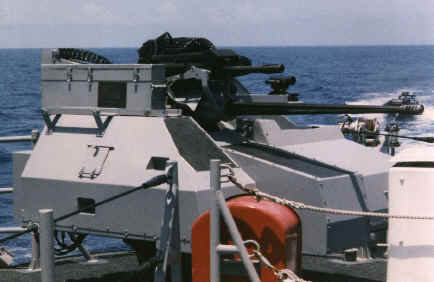
3. Secondary armament is poor. It consists of a .50 caliber machine gun on each side. The first lesson learned from the deployment of the US Navy's newer PC-1 patrol boats was that basic .50 cal mounts and the unstabilized MK-38 25mm chain gun had horrible accuracy mounted aboard a small, bouncing ship. As a result, the Navy developed a stabilized MK-96 25mm gun, which includes a 40mm automatic grenade launcher. (pictured) The LCS should have one or maybe two of these weapons and an EFOGM video guided missile system. The Navy recently admitted that more weaponry is required and various proposals are under consideration.
The LCS is the same size as a Fletcher class destroyer of World War II, but that ship had far more weaponry:
Five 5-inch (127mm)/38 Mk12 DP guns
Ten dual 40mm/56 AA guns
Seven 20mm/70 Mk2 AA guns
Ten 21-inch torpedo tubes
4. Where are the torpedo tubes? One of the LCS missions is ASW, but it has no ASW weaponry. Yes, it would have a helicopter, but what if the helicopter is broke down or off on a ferry mission? What if the aircrew is asleep or operating 100 miles away and a submarine or incoming torpedo is spotted? Most corvettes have torpedo tubes for ASW torpedoes, the LCS must have at least two. The LCS can carry the same lightweight torpedo as its helicopter, so its torpedo tubes are also magazines since those torpedoes can be removed and mounted on the helicopter if the situation warrants. If ASW is not a current mission, it can save weight and deploy without torpedoes.
5. Who thought up this maximum speed of 40-50 knots? This isn't a cigarette boat for teenagers. A 2003 analysis by David D. Rudko noted that the Navy has stated the LCS must incorporate endurance, speed, payload capacity, sea-keeping, shallow-draft and mission reconfigurability into a small ship design. However, constraints in current ship design technology make this desired combination of design characteristics in small ships difficult to realize at any cost. Speed, displacement, and significant wave height all result in considerable increases in fuel consumption, and as a result, severely limit LCS endurance and weaponry.
When operating in a significant wave height of six feet, regardless of the amount of fuel carried, the maximum endurance achieved for an LCS outfitted with all modular mission packages is less than seven days. Especially noteworthy is that when restricted to a fuel reserve of 50% and a fuel carrying capacity of Day tanks, the maximum achieved endurance is only 4.8 hours when operating at a maximum speed of 48 knots. The LCS can achieve high speeds, however, this can only be accomplished at the expense of range and payload capacity.
The requirement to go fast requires a seaframe with large and heavy propulsion systems. The weight of the seaframe, required shipboard systems (weapons, sensors, command and control, and self-defense) and modular mission packages accounts for 84% of the full displacement, and as a result, substantially limits total fuel carrying capacity. Since initial mission profiles required the high-speed capability less than 5% of the time, the end result is a ship that has very little endurance and a high-speed capability it would rarely use. Refueling, and potentially rearming, would require the LCS to frequently leave littoral waters and transit to Combat Logistics Force ships operating outside the littorals for replenishment.
In addition, big engines and a heavy frame make a coastal ship far too big. All other modern coastal ships around the world are half its size. Twice the size means twice the target and twice the cost, all this for high speed? The LCS is the size of modern frigates and bigger than destroyers of World War II, yet has the armament of a patrol boat in order to accommodate the mysterious ultra high-speed requirement.
5. The LCS is not diesel-electric; it must be.
An Interim LCS
The US Navy should scrap the failed LCS in favor of a slower, smaller, and more capable DE corvettes based on the Visby class corvette design and supported by tenders. Since a new ship takes years to develop and test, the US Navy should buy an excellent coastal ship now made in Mississippi, for Egypt! As part of American military aid, the USA contracted to build four Ambassador MK III ships (pictured). These 200 ft long craft are referred to as "missile boats" for political reasons. They are one-sixth the size of the LCS, cost half as much, are just as fast, and have twice the weaponry!
 Since the Ambassador is much smaller, it is much more
difficult to track and hit with weaponry, and has half the draft of the LCS,
which is extremely important for a coastal craft. It does not carry two
helicopters like the LCS, but those should operate far offshore, otherwise they
help an enemy locate and target the ship. There have been no reported problems
with the Ambassador since the foreign military sales office chose a simple
design using modern (proven) systems.
Since the Ambassador is much smaller, it is much more
difficult to track and hit with weaponry, and has half the draft of the LCS,
which is extremely important for a coastal craft. It does not carry two
helicopters like the LCS, but those should operate far offshore, otherwise they
help an enemy locate and target the ship. There have been no reported problems
with the Ambassador since the foreign military sales office chose a simple
design using modern (proven) systems.
A dozen LCS have been funded thus far with more planned. Everyone is disappointed as they break down often and carry little weaponry. They don't even have basic Harpoon anti-ship missiles and only a single 57mm deck gun, compared to the 76mm mounted on the small Ambassador! The US Navy should buy a couple dozen of these (with Hellfires or EFOGMs added) until a DE corvette is ready to join the fleet.
©2015 www.G2mil.com